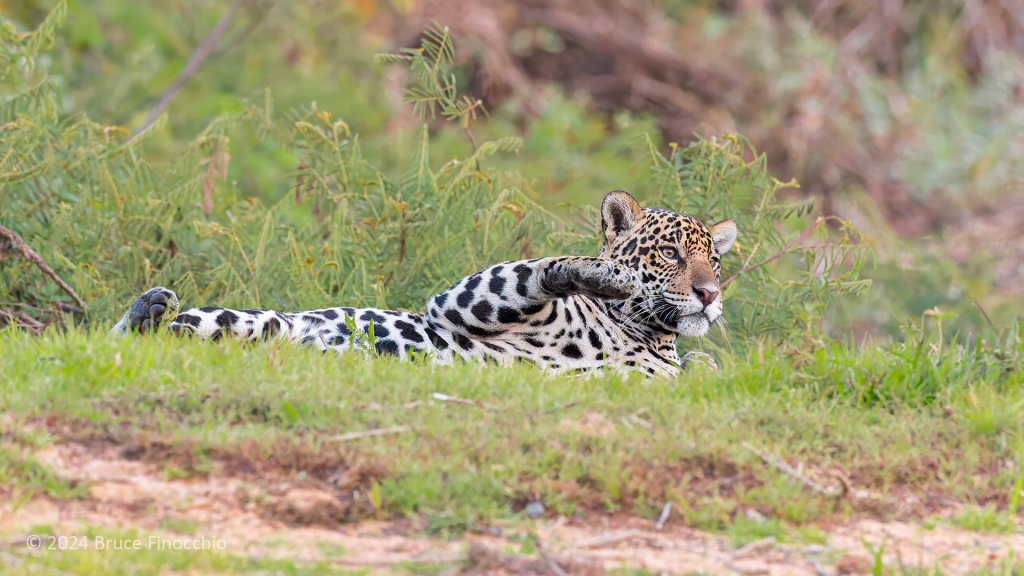
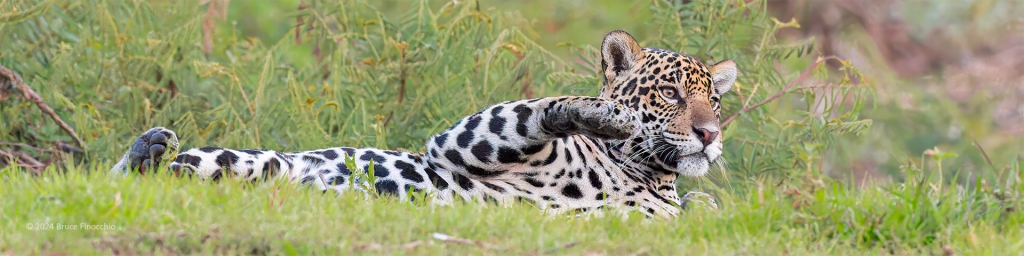
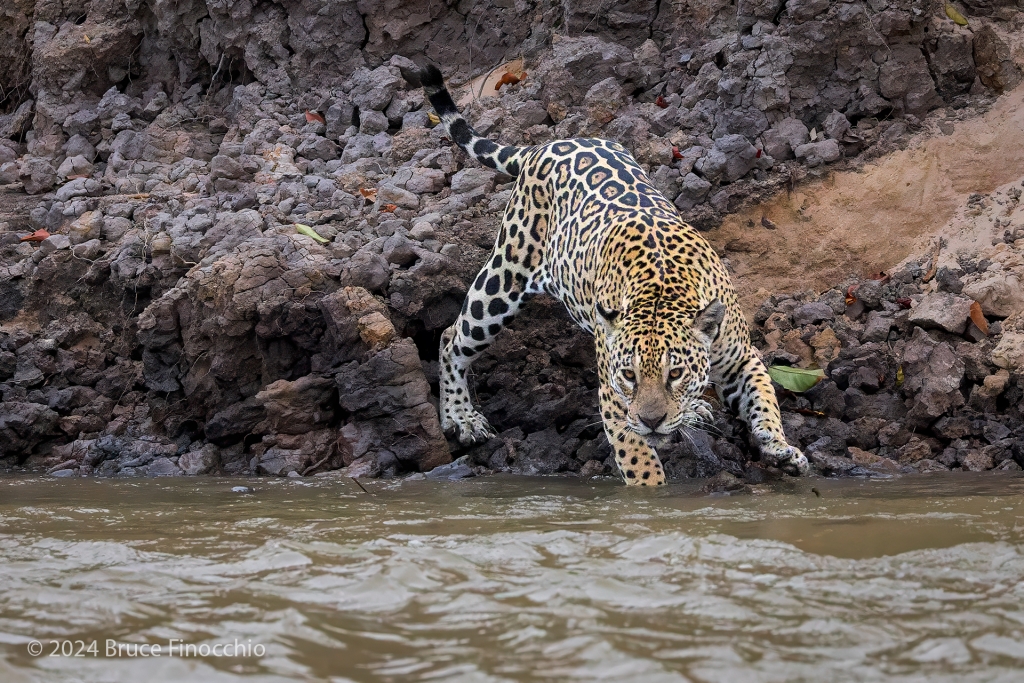
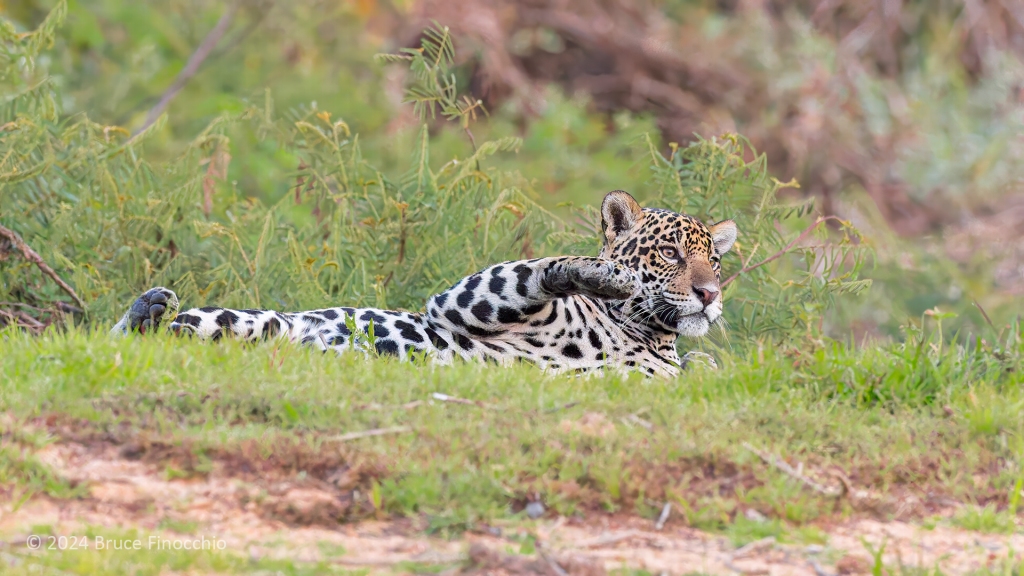
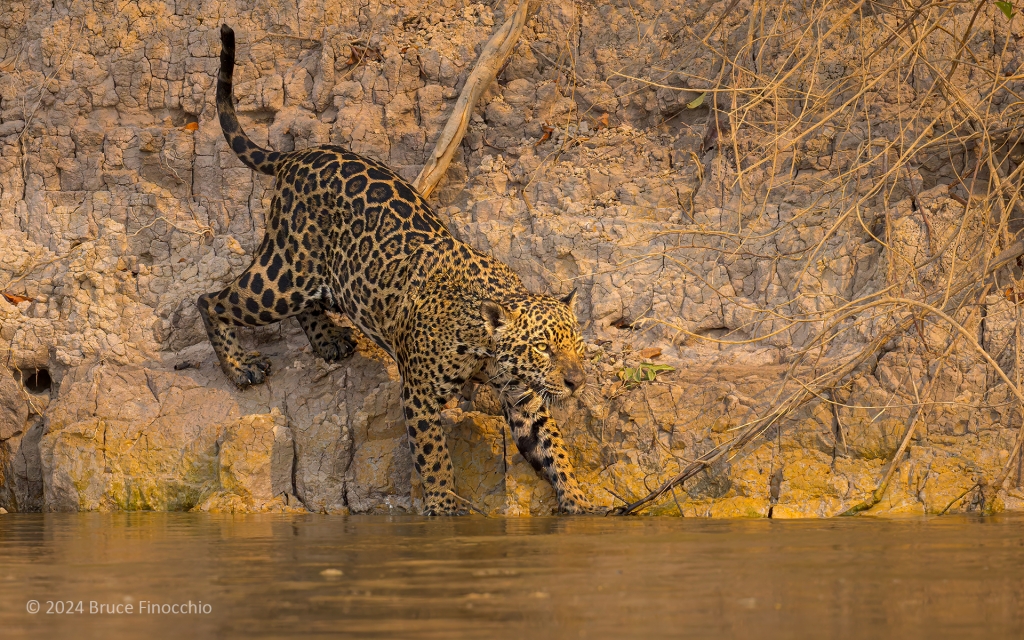
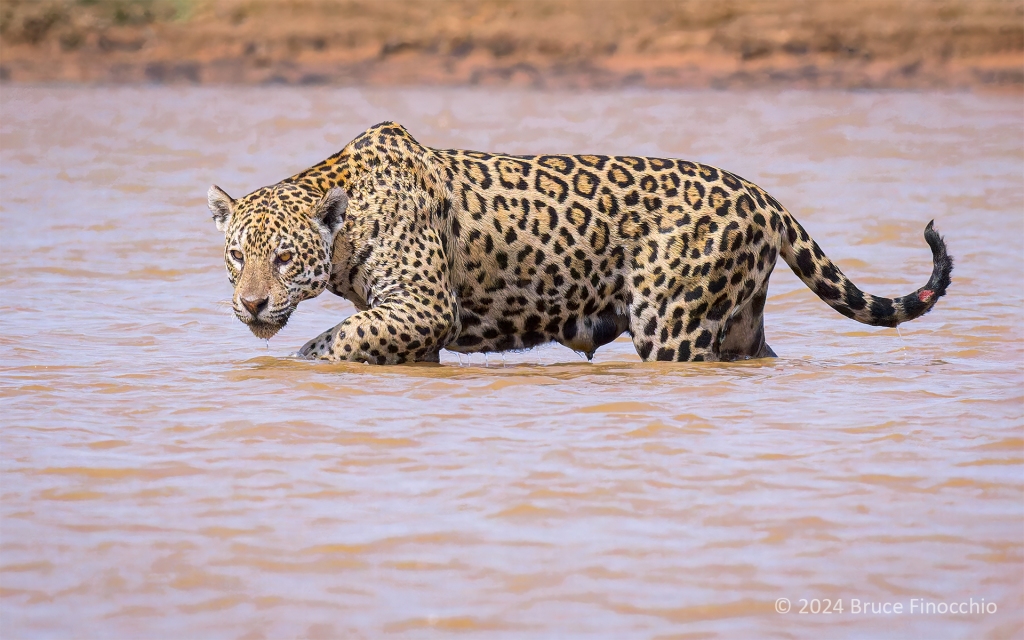
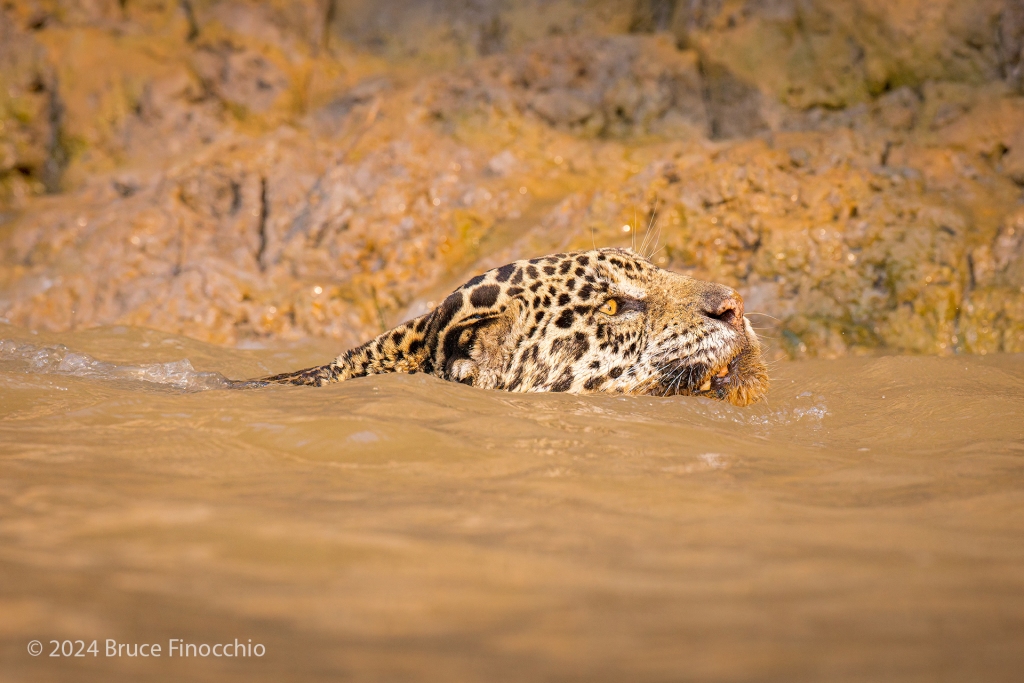
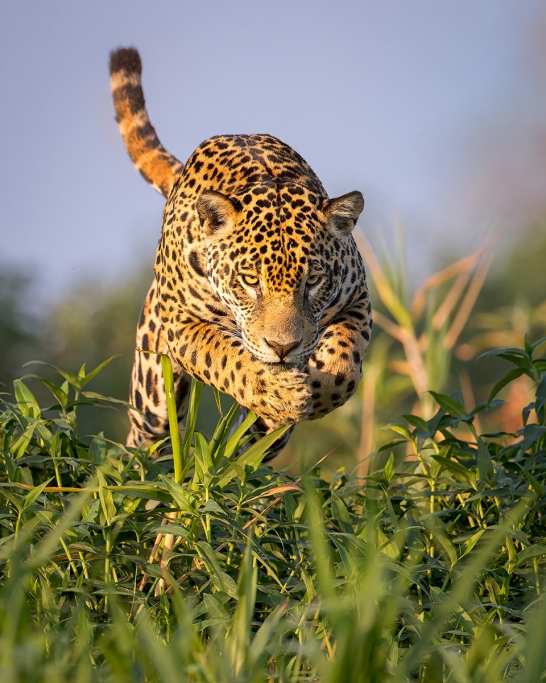
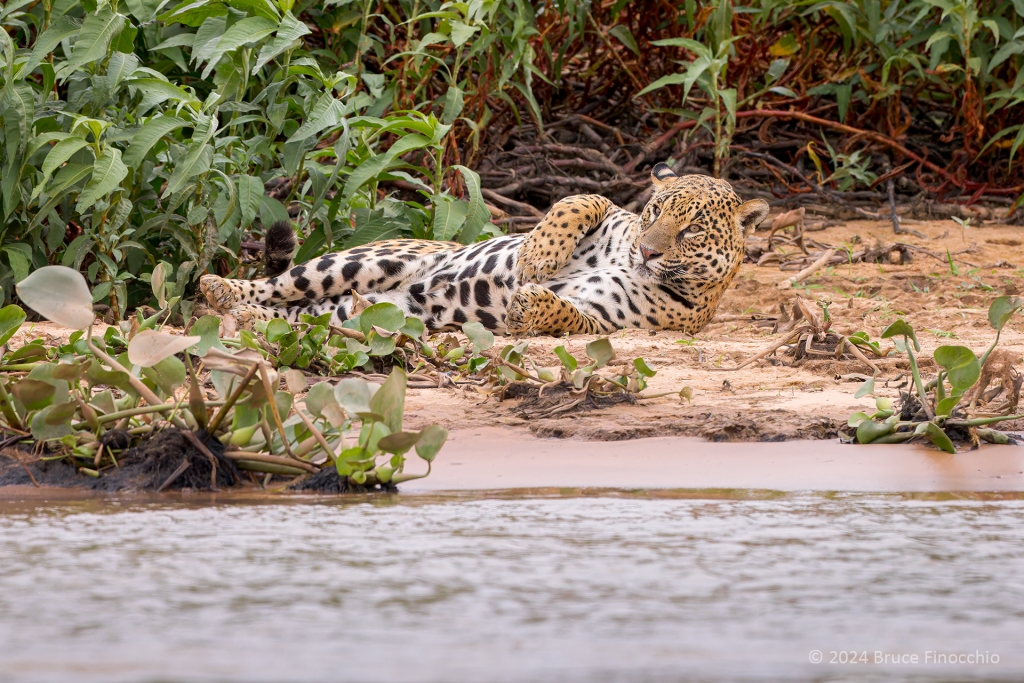
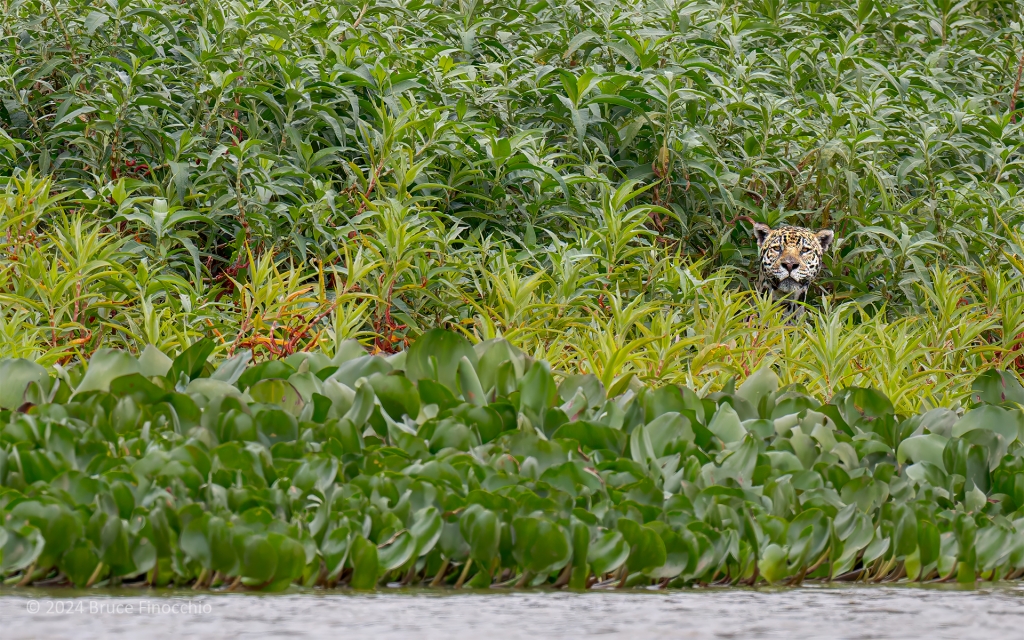
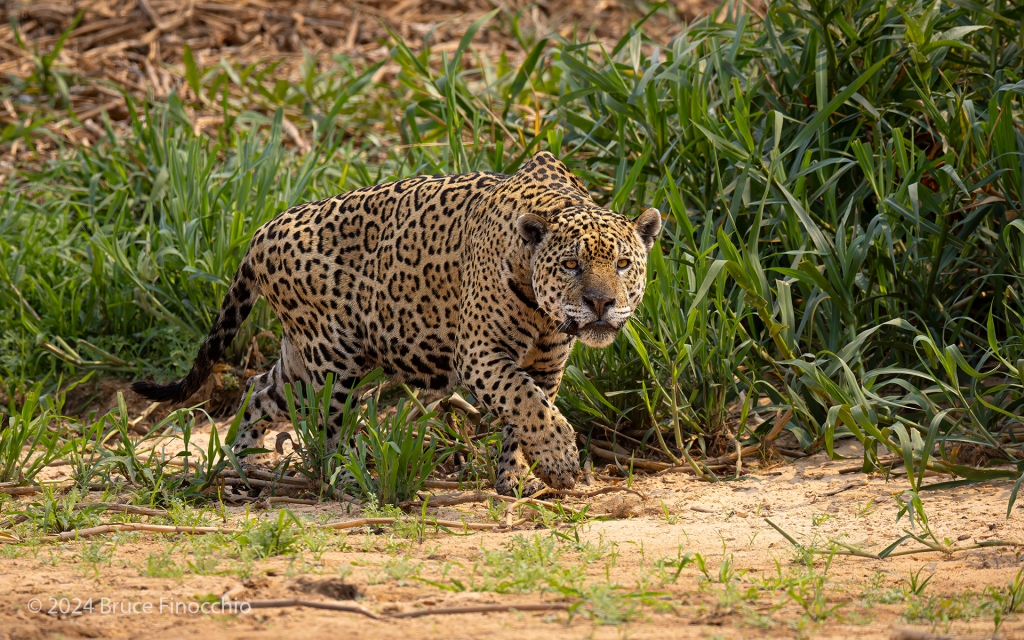
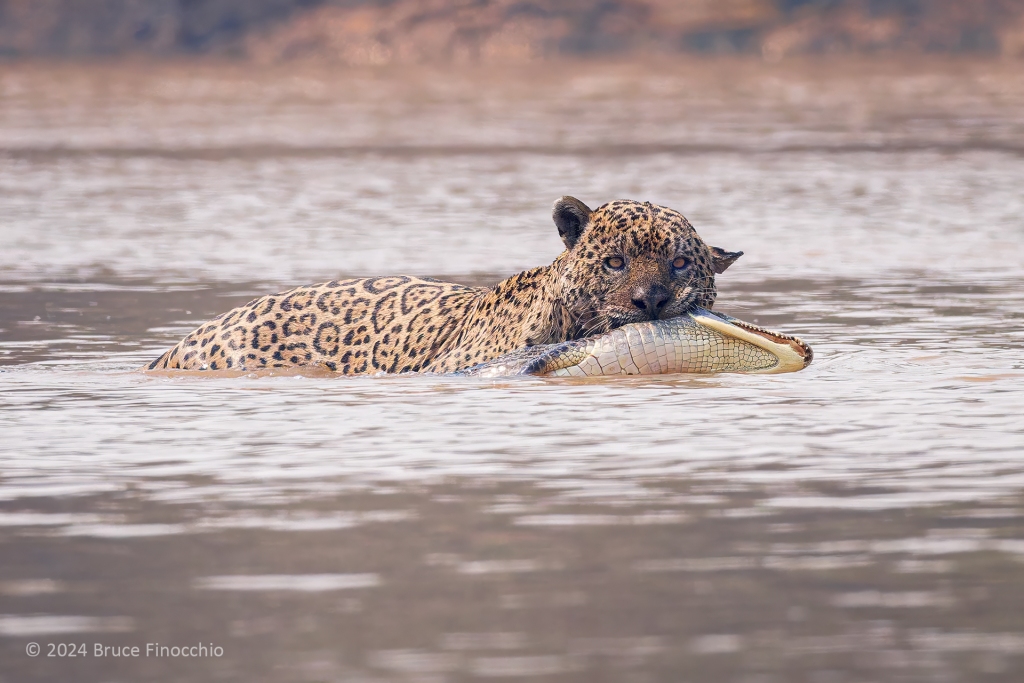
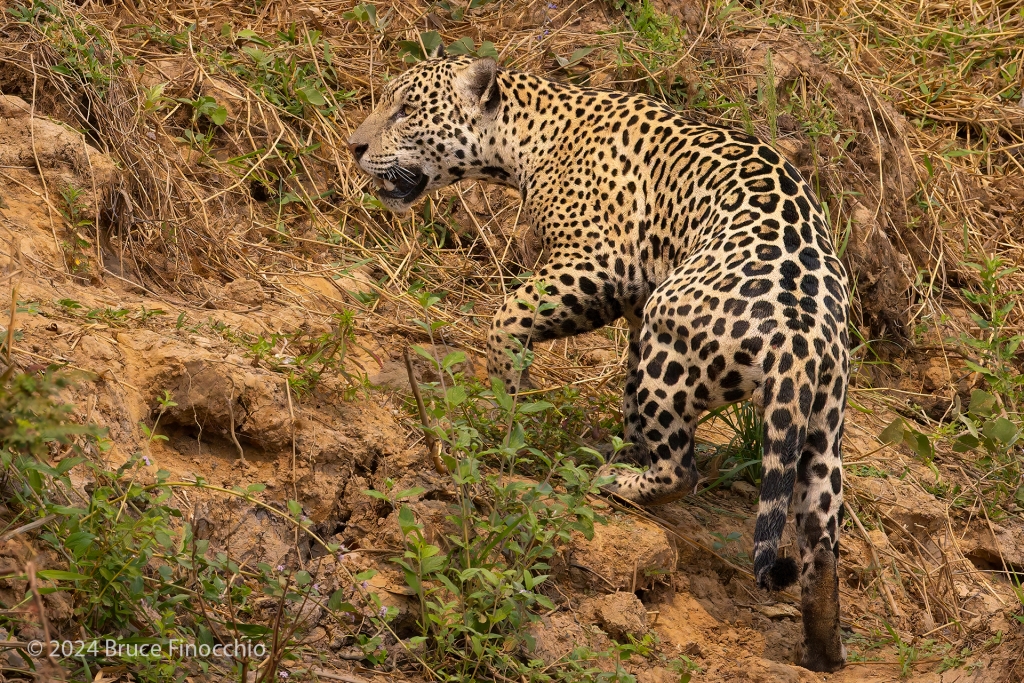
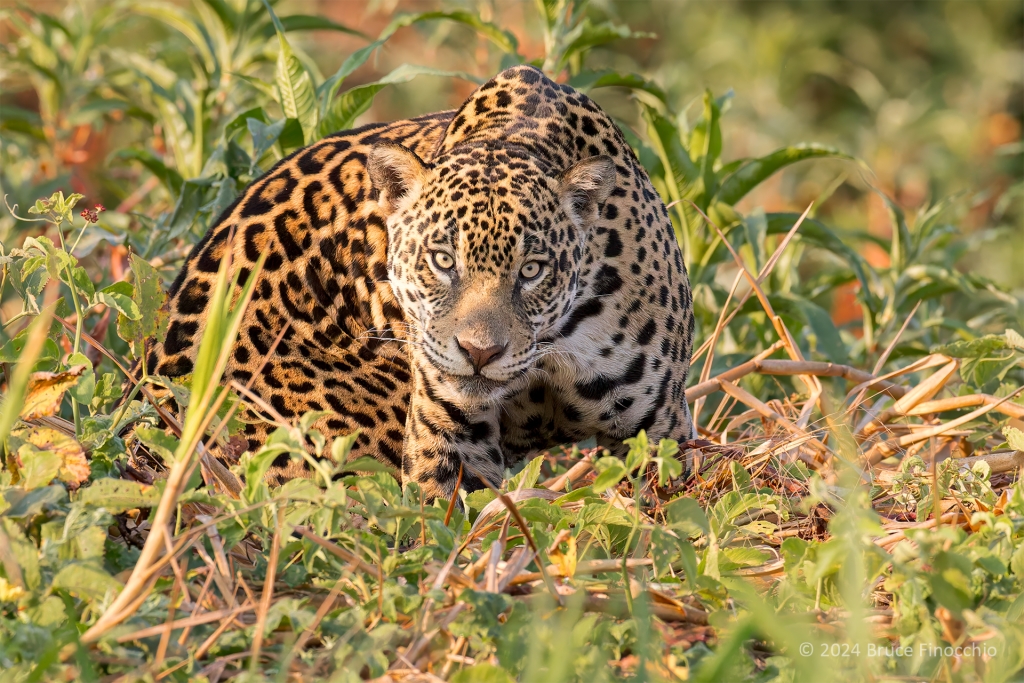
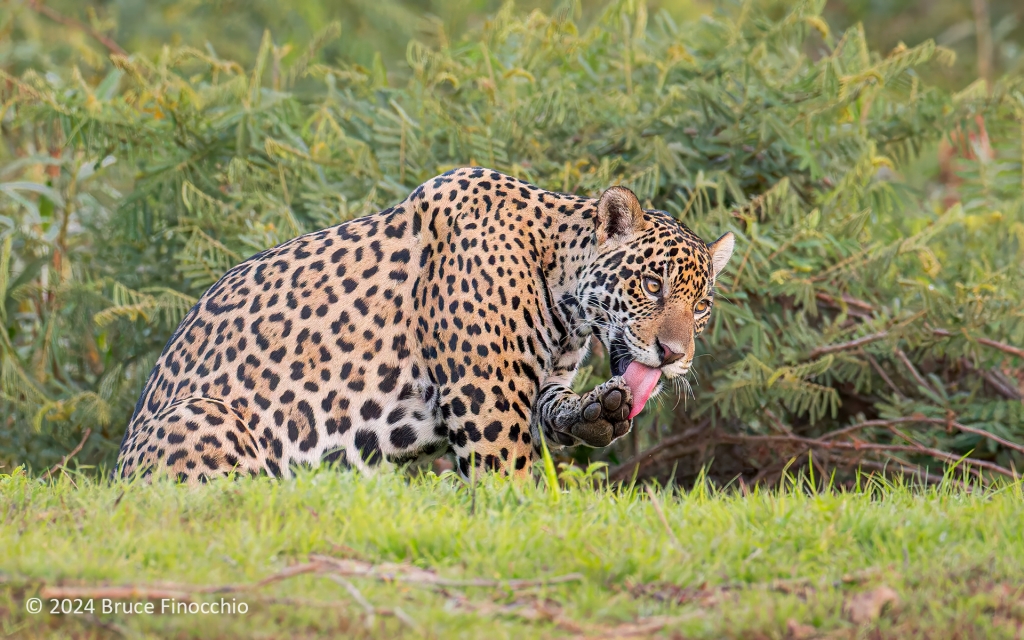
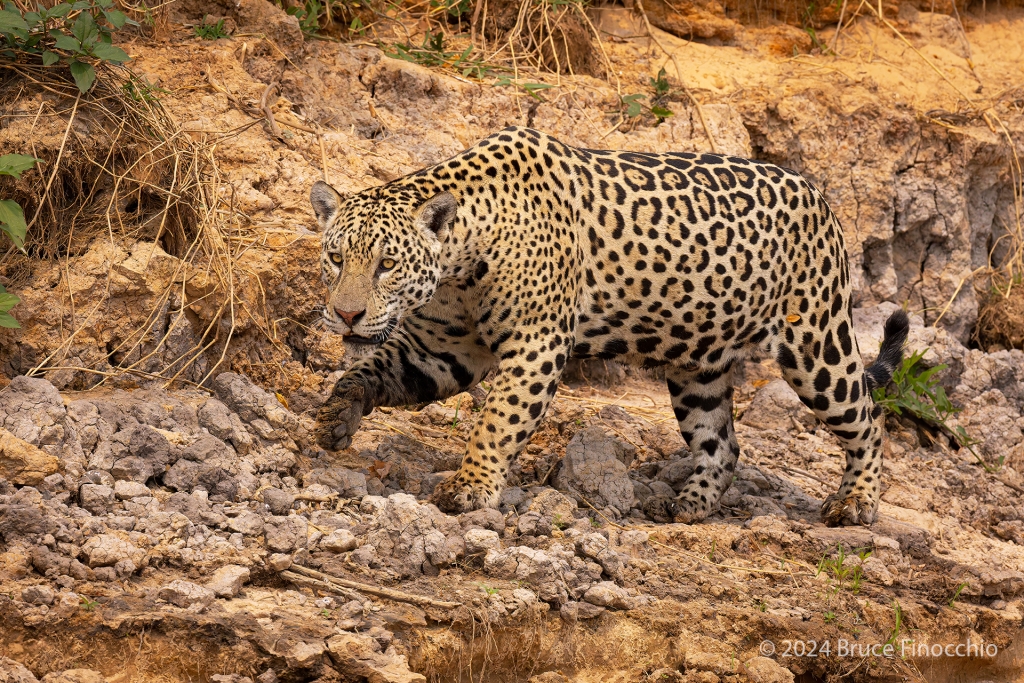
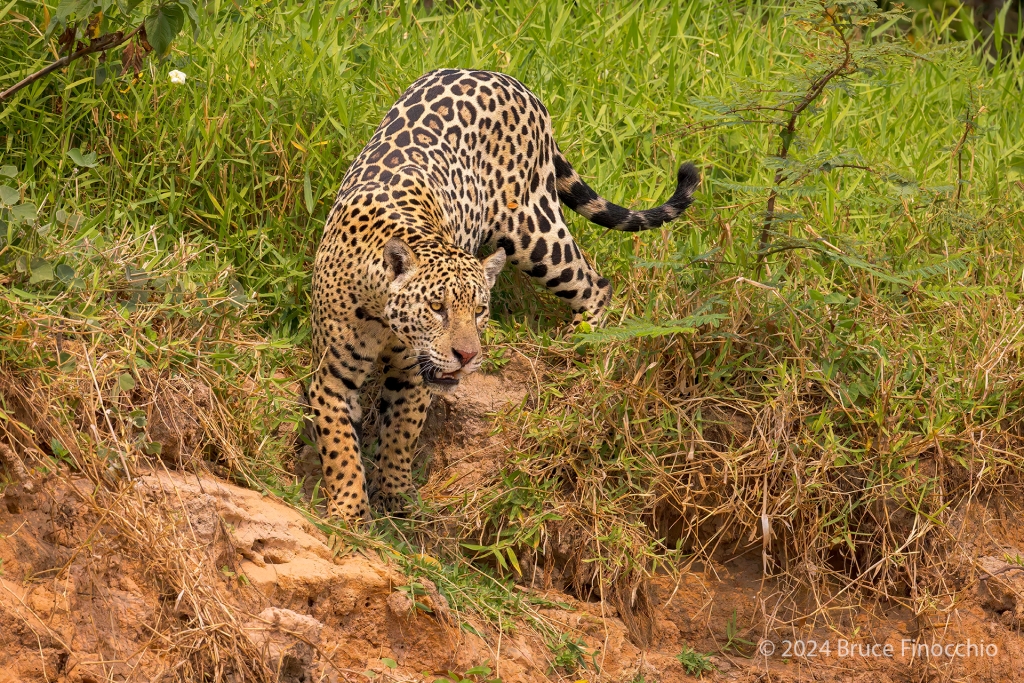
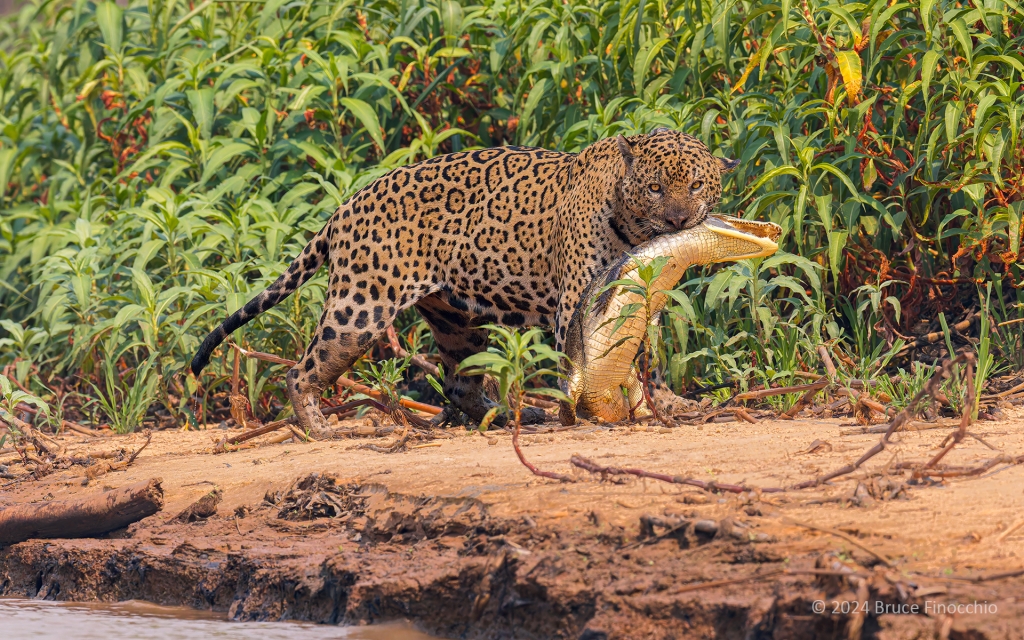
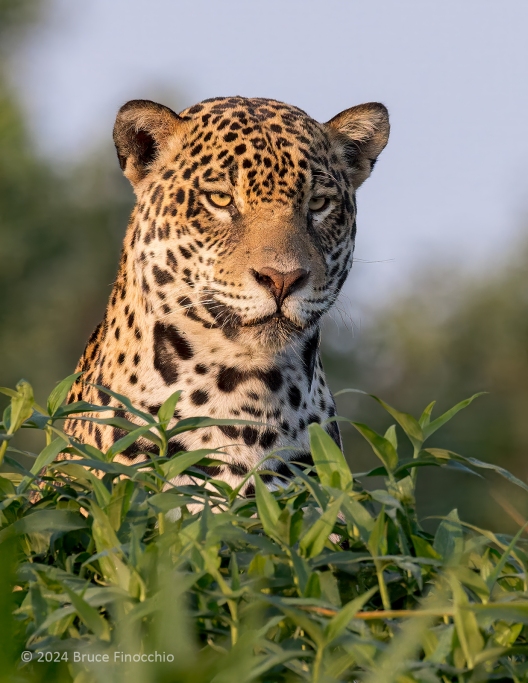
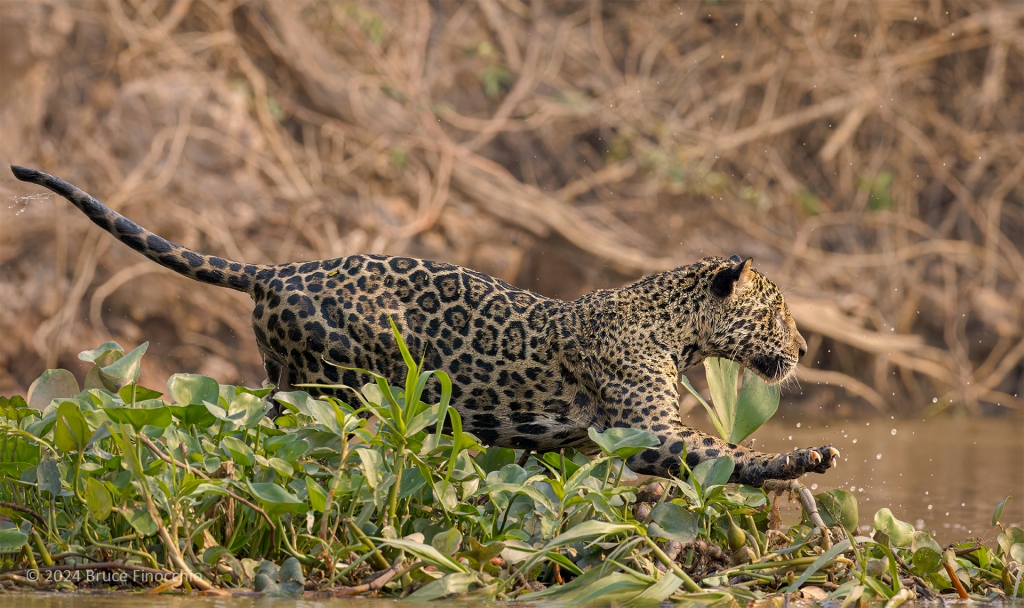
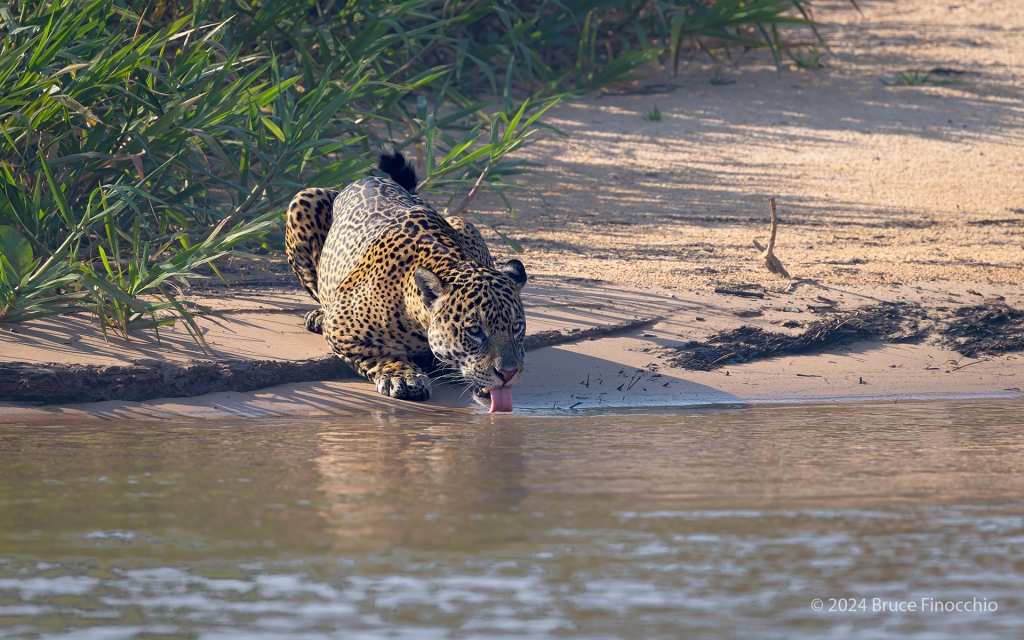
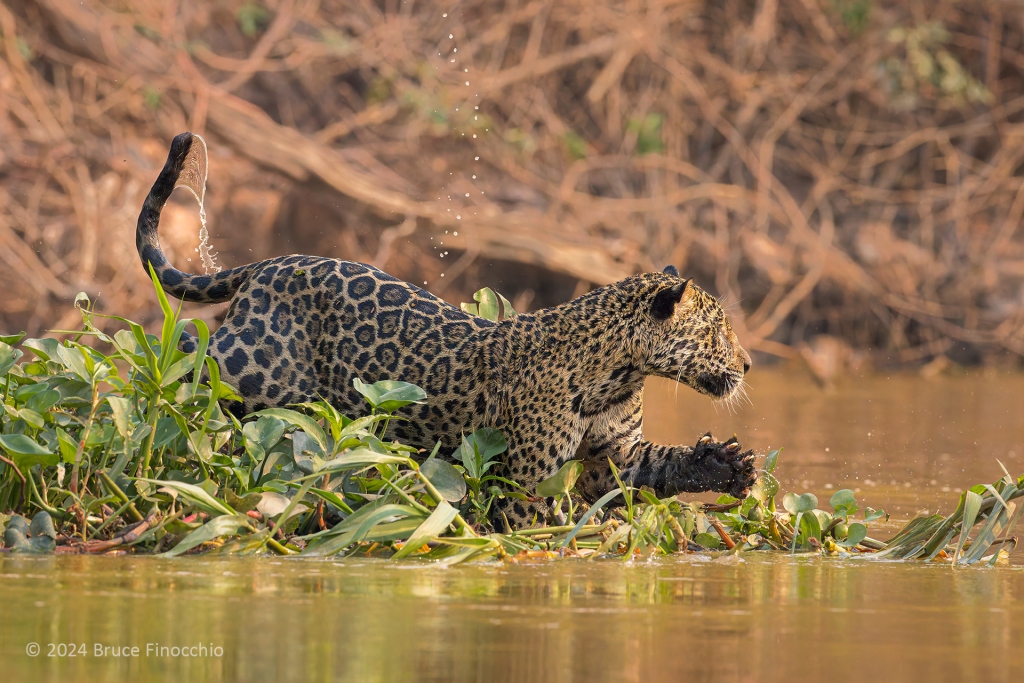
In the embrace of nature, where the vibrant greens of grass meet the fading light of a day’s end, a moment of pure magic unfolds. Here lies a female jaguar, alert and poised, her raised paw a testament to grace and strength. This captivating image invites us to pause, breathe, and reconnect with the sacred moments that nature so generously offers.
As I observe this magnificent creature, I am reminded of the delicate balance that sustains our ecosystems. The jaguar embodies the wild’s untamed spirit with its striking coat and watchful gaze. She rests not merely as a predator but as a guardian of her realm, reminding us of the importance of preserving these majestic beings and their habitats.
As an artist, I strive to open doorways to these enchanting experiences. Each photograph I capture is more than just an image; it’s a portal into the soul of nature. It beckons us to experience a child-like wonderment, to feel the pulse of life that courses through every blade of grass and every creature that roams the earth.
This alert yet serene jaguar embodies a moment of tranquility amidst the chaos of life. She invites us to reflect on our connection to the natural world. Are we taking the time to appreciate the beauty that surrounds us? Are we nurturing our spirit and allowing ourselves to be enveloped by the awe of existence?
Through my work at Dream Catcher Images, I aim to instill a sense of harmony and oneness with nature. Each click of the shutter reminds us we are all part of a more remarkable tapestry woven together by the threads of life. The sacredness of this moment, captured in time, serves as a gentle nudge to protect and cherish our wild places and the creatures that inhabit them.
Let this image of the alert female jaguar inspire you to seek out your sacred moments in nature. Embrace the stillness, listen to the whispers of the wild, and allow your spirit to reconnect with the earth. Together, we can foster a deeper appreciation for the beauty surrounding us and work towards preserving it for generations.
“To me, cruelty is the worst of human sins.” ~ Jane Goodall.
“Change happens by listening and then starting a dialogue with the people who are doing something you don’t believe is right.” ~ Jane Goodall.
Pantanal’s August 2024 Jaguars
(To see larger images, click on one)
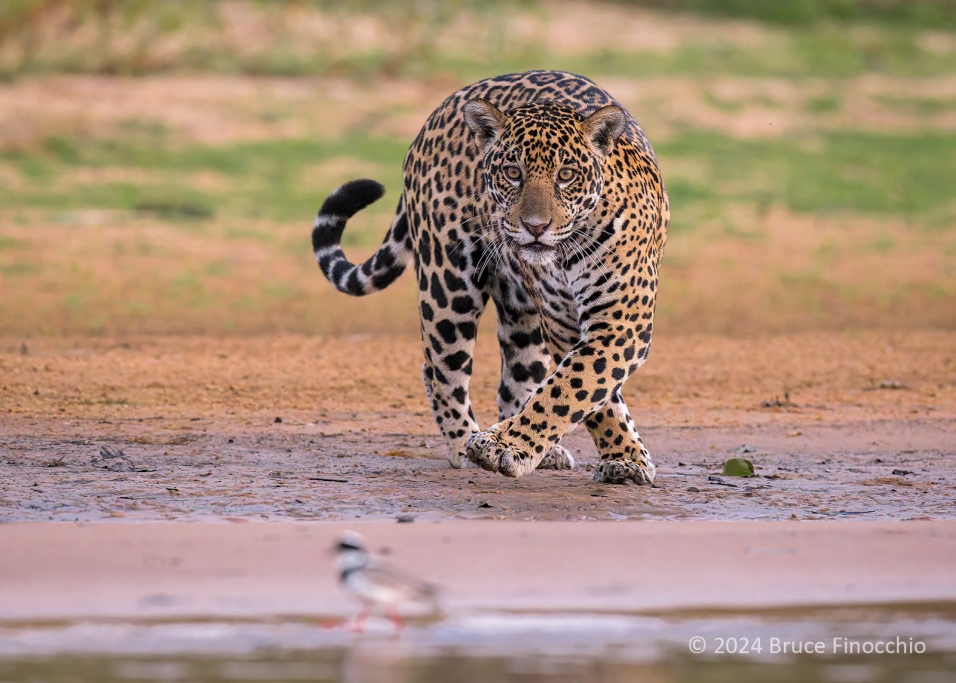
Female Jaguar’s Cat Instincts Kick In As A Pied Lapwing Walks In Front Of Her
The movement of this female jaguar is so cat-like, like domestic kittens and cats, so familiar and instinctual, ready with a desire to stalk and pounce. It’s heartwarming, reaches our souls, and brings a smile of joy to our faces.
It’s love for me because I love big cats, and my vision is to capture moments like this that tell a story and touch the viewer. It is a fleeting moment, a gesture that lasts less than a second; as a wildlife photographer, you need to be ready, focused, patient, and have an intense concentration. The more you learn about the animal, its habits, behavior, personality, and environment, the greater the anticipation of the right moment to capture the decisive moment successfully.
The challenge is substantial, but so is the reward—pure clarity resulting in true beauty.
My Pantanal trip was so wonderful in different ways, yet these special moments of connecting with an animal’s life and witnessing and observing their lives are unique; they stay with you forever! It is a humbling experience for them to allow you into their world, even for a brief time.
It’s what I love about wildlife photography, and I will do it as long as possible.
“In the eyes of a wild jaguar, we see our own emotions reflected at us—a mirror of the soul!” ~ paraphrased by Bruce Finocchio
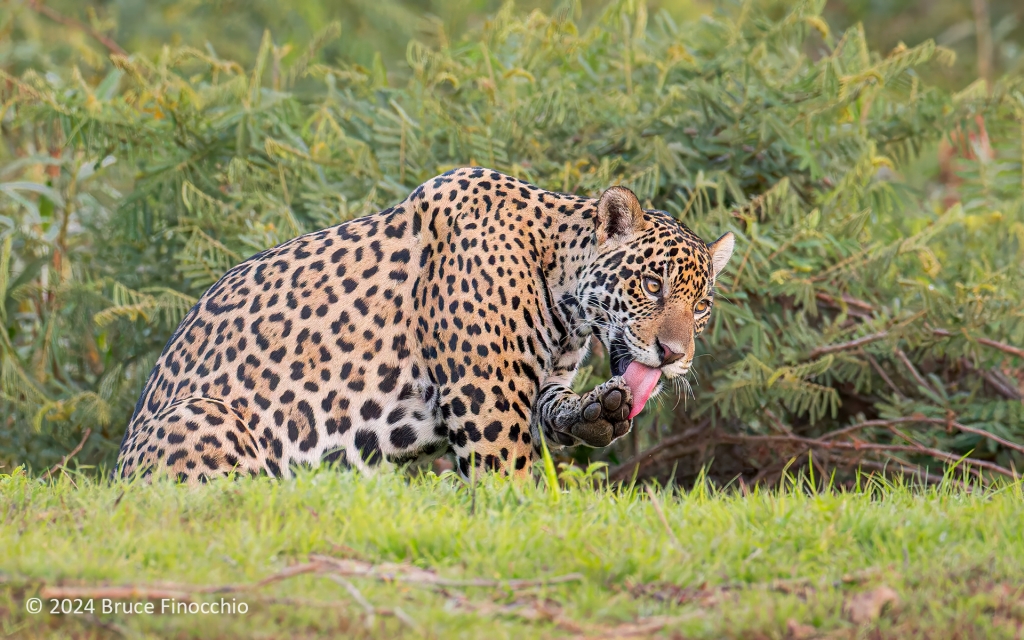
Female Jaguar Uses Long Pink Tongue To Lick Off The Top Of Her Paw
As A Female Jaguar Rolls Over, She Intently Checks Out Her Surroundings
Side Profile Portrait Of A Male Bobcat With An Intense Stare
IMAGE STORY:
During a fall early morning, in my blind, I caught some movement at the corner of the blind. I took a peek, and this Bobcat was staring at me. I lean back and reach for my 100—500 mm Canon Lens. Knowing he was too close for my 600 mm f4.0 telephoto lens, which I was using to capture small birds. I was slow and deliberate. I knew that quick movement would scare him off. With the camera ready, I slowly move him into view around the corner of the blind window. He was looking at me, about twenty feet away. I took a few safety shots with the corner of the blind in the frame. I waited for his next move. He walked toward the pond, and I got a couple of images of him in the vegetation before he reached the pond, with some black sage in the foreground. Then, he continued walking across in front of me, in front of the pond. For both images, I zoomed the lens open and down to 100 to 200 mm to include all of him in the frame.
Intentionally, I sit in the very back part of the blind, so my 600 mm lens doesn’t stick out of the blind window. So when I move the lens, the movement isn’t seen. Movement renders me visible, causing and activating the danger signal for the birds and the Bobcat.
During Early Morning, A Bobcat Walks Out Into The Open From Thick Brush
At the edge of the pond, he stopped and stared at me. It seemed like minutes; I zoomed in tight for a face portrait and took many shots, as usual. Then he walked away from me toward the brush line. Stopping again halfway there, looking back at me, more face portraits. Then, unconcerned, he walked toward the brush again and stopped to look down the field toward my cabin. Here, I switch to my 600 mm lens and capture the excellent side profile where you can see the transparent cornea of his eye. The dried chamise blossoms of the brush line created the beautiful purplish bokeh.
While the Bobcat was walking away, I saw it was a male. That’s why I have been referring to him.
Maybe five minutes at most. However, this is one of my most incredible wildlife encounters with a wild animal. These five minutes will live with me for the rest of my life. I am humbled and grateful to this Bobcat for allowing me to experience his wildness and spirit in a completely natural, fearless way—for accepting me into his world!
A short time ago, I observed many images of a very young bobcat taken at a game farm by a photographer friend. Observing them, they felt like a house cat playing with a feathered lure, which is what they were using, and the bobcat kitten was playing like a house cat.
As a comparison, I remarked to a client’s comment about my images, with this, “Yes, it was a spiritual experience. The way he moved and muscles worked, the looks he gave me, to be so close, to watch him be so aware. There was a particular and extraordinary wildness about him I will never forget.”
ABOUT:
The Bobcat, also known as the red lynx, is a medium-sized cat native to North America. It ranges from southern Canada through most of the contiguous United States to Oaxaca in Mexico. They listed it as Least Concern on the IUCN Red List since 2002 because of its wide distribution and large population.
A long-legged cat with large paws, a relatively short body, and tufted ears, the Bobcat is 60–100 cm (24–40 inches) long, excluding the 10–20-cm tail, stands 50–60 cm at the shoulder, and weighs 7–15 kg (15–33 pounds). Its fur, stiffer and less valuable than the lynx, is pale brown to reddish with black spots. The underparts are white; the tip of the tail is black above and white below.
Full Face Portrait Of A Bobcat Empathizing His Eyes
“Wild animals never kill for sport. Man is the only one to whom the torture and death of his fellow creatures is amusing in itself.” ~ James Anthony Froude
“The difference between humans and wild animals is that humans pray before they commit murder.” ~ Friedrich Durrenmatt
Sow Grizzly Bear Pauses During Her Walk Across The Sagebrush Of Soda Butte Valley
It had been a long time since I was in Yellowstone National Park. My two previous visits were in the winter, November 1999, and February 2001—a long time ago. Therefore, I was excited to take a workshop or photo safari from wildlife photographer Brent Paull.
This would be my first fall visit to Yellowstone. We would also spend three days in Jackson Hole National Park. A National Park I had never visited before. Even though it was early October 2020, the Yellowstone landscape was parched. No measurable rainfall had fallen for quite a while, mirroring the rest of the Western United States. The park air was hazy and thick with smoke, coming from the fires burning in California and some other local fires.
We only had one grizzly bear encounter while in Yellowstone. We were driving back from the Beartooth pass, passing through Silver Gate and Cooke City at the Northeastern entrance to the park. We were coasting down the Soda Butte Valley heading to Lamar Valley when we saw a group of cars parked on the side of the road.
Our practice was to see what the congregation of cars was about. What wildlife were they seeing? As we arrived by the parked cars, we slowed down. A group of young ladies in a passenger car responded to our question of what wildlife are you seeing? One girl, in particular, standing through their sedan’s sunroof, said she saw wolves in the distance across the sagebrush toward Soda Butte Creek. Brent stopped our car and went out to look for himself with his binoculars. As he got his first look, the girl standing up in her car, exclaimed “bear”, and Brent agreed with her new species call.
The girls had foreign accents and long dark hair with dark eyes. Later, I began calling them the “Italian Girls”, because their accents sounded Italian, although they could have been from Portugal or Argentina, or any other Latin country in Europe, Central or South America.
Brent planned our course of action, as the bears, a sow with two cubs, were quartering closer, heading to where we were previously, so we reversed course and drove back to the last pull out behind us. This was so we could get photos of the bears walking towards us. The bears had just crossed the Soda Butte Creek coming from the other side of the valley, and their fur coats were wet from the river crossing.
I wish I had taken the time to change my camera body, from my old Canon 7D Mark II to the new Canon R5 body, that I had just received one day before I left on this trip. If I had, the quality of the raw captures would have been better, resulting in images of better technical quality.
Everything happened so fast, so quick. Brent got out of the car but told me and his other clients for safety to stay in and shoot through the windows, as the grizzly family was fast approaching our car.
It was hard shooting out of the window from the passenger side, moving around to get the best view was difficult because of the cramped conditions. As more vehicles stopped, the approaching grizzly bear family sensed the people and cars along the road. At one point, all the grizzly bears stopped and stood on their hind legs. I tried to concentrate on one, this cub with the more blond fur coloring around its face and head. Thus, I missed all three briefly standing up at once, as Brent mentioned later—a shot he captured.
It was mid-day when this encounter happened; it shows that even at 2:45 PM, you can see animals moving around and active. The more time you spend looking for wildlife; the more you increase your odds of seeing something. Here many would have been persuaded to head back to the hotel because of the warm mid-day temperatures and smoky skies, believing that no wildlife would be out and moving around during this time of day.
Even though this encounter was less than fifteen minutes, it will be a moment I will never forget. It will be forever engraved on the viewscreen of my mind. To see this grizzly bear family up close and to share a moment in their lives is something special, so incredible; it’s hard to describe and to put into words.
All the hours of patiently searching for wildlife and driving the roads of Yellowstone paid off in ways more numerous to quantify. I was blessed with this sighting and encounter, and these images will always bring back those moments I shared with this grizzly bear cub, its sibling, and its mother. It was a spiritual experience.
As an aside, I believe Canon has come up with a great mirrorless camera body. In the R5, the autofocus and eye-tracking feature, in particular, is outstanding. Even my old Canon lenses like the 100 -400 mm IS lens II and even my older original 600 mm f4.0 IS lens, first produced in 1999, have autofocus capabilities that are so much faster and accurate, than with my Canon 7D Mark II camera body. The files are noticeably sharper and clearer, with much detail, even in the new compressed raw file format. The extra 45 megapixels compared to the 21 megapixels of the older camera body, will make enlarging subjects by cropping so much easier and more successful.
2. OVERALL SHOOTING GOALS:
Goal: My goal was to capture images of grizzly bears exhibiting some kind of behavior.
Equipment/Source: Canon 7D Mark II Body, EF100—400 mm f4.5-5.6L IS II lens with a 1.4x teleconverter, at 189 mm, 1/2000 of second, f8, ISO 1600, Aperture priority, Evaluative Metering.
Technique: Hand holding lens and camera body while resting arms on the car’s window ledge.
Post Processing: Nik Dfine 2 noise reduction on the out of focused sagebrush, plus a mid-tone contrast adjustment, and cropped down from a horizontal format to make a vertical frame for the bear cub images. Selective darkening of lighter sagebrush areas. Lightening of the bear cub’s fur and some highlight reduction in camera raw. Nik Pre-sharpening on the bear cubs subjects. A little work on the bears’ eyes, with a paintbrush set to the Overlay blending mode, with very low settings of 8 opacity and 14 flow, using white to lighten and black to darken its pupil.
Mother Blue Wildebeest Greets Her Newborn Calf For The First Time
This image is from my February 2019 trip to East Africa. We were staying at the Ndutu Safari Lodge, at the southern edge of the great Serengeti plains, and one morning heading south we saw a birth of a Blue Wildebeest calf. I didn’t catch the birth, but this is the moment after when the mother turned around and first greeted her newborn calf.
Later in the day, further south, at the Ubuntu pans, a pack of wild dogs (Painted Wolves) was hanging around the muddy water there. Unfortunately, they had a very young Wildebeest calf just walk right up to them, and the temptation was too great. They just literally torn the calf apart and we watched and photographed the whole violent seen. Good for the dogs, but not for that poor Wildebeest calf.
So that day, and afterward, we kept saying to ourselves, “one in and one out”. That’s how it goes sometimes for the Wildebeest calves.
A Pack Of Wild Dogs Literally Pull-Apart A Baby Blue Wildebeest
Young Lion Cub Takes A Breather From A Lion Buffalo Kill Feeding Frenzy
It was our first full day in Serengeti National Park. We spend the morning cruising the tree line river beds, of the Central Serengeti, looking for Leopards in the riverbed trees. When our driver and guide received a message on the safari guide’s short-wave radio that a pride of lions had killed a Cape Buffalo just north of our area. It was about a forty-minute drive from our current location. And yes, the Serengeti is an enormous place, so this location was relatively close.
We decided to change our plans and head there. Soon we began to see other Land Rovers also heading that way. When we top the final rise, it was easy to spot the kill because there were at least twenty-five vehicles surrounding the feeding lions.
Then, the dance and jostling for vehicle position began. I was disturbed by how close some Land Rovers were to the lions. The vehicles formed a semi-circle around the lions. More and more vehicles kept coming in, as we finally found a clear space to view the lions feeding around the kill. It wasn’t easy, specifically; we found a small window to shoot through the sea of vehicles, and yet the kill was still a decent distance away.
For us with large telephoto lenses, it wasn’t necessary to be that close to the lions. Other safari vehicles with only cell phones viewers seemed overly aggressive pushing ever closer to the lions to get a better shot. In some cases, close as five feet away. I find this human behavior stressing to the lions and other wildlife of the Serengeti. No matter how important getting a close portrait image is to the photographer, nothing justifies getting this close and alternating their natural behavior and adding stress to their hard and difficult lives.
Maybe, I am being too hard on the paparazzi and human beings, by having some expectations that people have ethics and will take the right action, like putting wildlife first, before themselves. Let’s face it, I too am part of this dance. I am taking part too, and this sickens me. I want this changed, for it gives photographers a bad name and puts the negative spotlight on all of us.
Pride Of Lions On A Cape Buffalo Kill With Safari Vehicles Close By
I am digressing and giving some background information. This image of a lion cub above taking a momentary break from feeding was captured later in the day close to evening. After our late morning encounter with the feeding lions, we left, and late in the day, decided to go back. I am glad we did because in the middle of the day there were no lion cubs at the carcass. We also thought there would fewer vehicles there around the feeding lions. In reality, there were fewer, but still a lot of vehicles.
There were other members of the large pride now including at least three, four-month-old cubs, which were feeding on the buffalo carcass too. What was so amazing was that they were actually feeding inside of the abdominal cavity of the buffalo while adult lions’ mouths were feeding inches away from them. We could barely see them, and at times they were completely inside of the belly of the buffalo. It was a wonder that one of the adults didn’t bite down on the bodies of these cubs, as the adults moved their eating positions and their chewing mouths.
I captured this image as one of the cubs came out of the belly of the buffalo to take a momentary break from the feeding frenzy. This scene of the cub’s side by side with the feeding adults, disappearing into the abdominal cavity for their share is something I won’t forget. The determination of these little lion cubs and their audacity to get their share was something to behold.
Trapped Lion Cub Within A Buffalo Carcass Feeding Frenzy
The desire for life is strong and here it was so clearly visible with these cubs. A remarkable moment and a life lesson, which observed has the power to change and affect your own life. The dichotomy of how we behave, with the actions of the vehicles, ever crowding closer and closer for some hungry connection to these wild animals, to the purity of how they live their lives is very striking. And I am afraid, not a good or shining example of mankind’s behavior and not best actions towards the natural world.
It is my sincere hope that my lion cub image can put your heart in the right place, and all of us can do more to save this iconic species before it is too late and another species goes extinct at the hands of man.
Postscript:
There are other places in Africa that place limits on the number of vehicles around an animal. I know for a fact, Londolozi, in South Africa, has a three-limit vehicle rule. If a fourth vehicle wants to view the kill, this vehicle must wait until the first vehicle or one of the three leaves the scene, before it can approach the sighting. Maybe, three isn’t the appropriate or right number for the number of vehicles traversing the large Serengeti. Ten perhaps? Or maybe establishing a 75-foot rule, where no vehicle can come closer than this distance, is a better solution.
In Ndutu, there is a plaque on the lodge wall stating this 75-foot rule for Cheetahs. I believe this policy should apply to all large African mammals, especially for the big cats. There is room too for common sense, and judgment based on how the animal reacts and whether the animal is accustomed to vehicles. If the animal closely approaches you and the vehicle peacefully you need to stay put, be silent and let the mammal pass—panic doesn’t help either cause.
If the truth is told, while on safari and expecting to get portrait images of lion cubs, a telephoto lens is required, and you can’t rely on a cell phone for these types of images.
Saturday was a full day, and a productive day spent with a client at my beloved Ramrod Ranch. We photographed many bird species. The House Wrens nesting a knothole in the cabin particular provided lots of photo opportunities, as the parents brought in worms and spiders for the young ones who’s voices you could hear calling out for food.
Still, it was a long day, up before 5:00 am, and I was exhausted after the client left. I normally would work on my images from the day until 11:00 pm or so. However, I was so exhausted as the day turned to the night, that I just plopped down on my bed and went to sleep. I was too lazy and tired to even charge my sleep machine battery and went without.
All these factors contribute to a Sunday where I was still very tired. I wasn’t about to miss a morning shooting in my blind at the Upper Pond. However, during the morning in the blind, I kept nodding off. A couple of California Quail came up to the perches that surrounded the pond; it was their constant chuckling that woke me up.
The female and the male flew up to my raptor perch. I took several images of them both. The female quail stayed longer and started calling out. Photographically, I was having a hard time fitting her image into the frame. My 600 mm IS f4.0 lens is sometimes just too tight, and this was the case here.
Female California Quail Calls Out From Behind A Old And Gnarled Oak Branch
I had my 100—400 mm lens with me in the blind just for this case. As I took my camera body off the 600 mm lens, putting on the shorter lens, I looked up and saw that the female quail flew into the little blue oak tree that’s right behind the pond, and out of sight. My frustration was high, for it appeared that I changed the lens in vain, and for nothing.
With the 100—400 mm lens and camera on my lap as the minutes ticked by, I noticed a change in the quail’s chuckling coming from the little blue oak tree. It was different, and I was instantly alert. For these calls were their warning calls that a fox, bobcat, or some other predator was nearby. I had heard them many times before.
I looked out toward the brush line where the jeep road goes up the mountain and walking into my sight line appears a beautiful bobcat. For once I was prepared with the right lens, for all I had to do was raise the camera up from my lap. It has taken many years of coming close and many missed opportunities, I finally had my chance to capture a good image of Bobcat. I have seen them around the ranch many times over the years. My clients have got images of them from the same pond. Somehow my luck and fortune through the years weren’t good.
The bobcat might have come up to the pond to drink, like the Gray Foxes, have over the years. However, I think it heard the clicking from my camera shutter and after about thirty images it turn around and disappeared into the brush. For next time, I need to use the silent shooting mode that’s available on my Canon 7D Mark II camera body, for this mode really reduces the noise coming from closing and clicking the shutter. Then, I might get that coveted drinking image.
Bobbed Tail Up As Alert Bobcat Searches For Prey
The male and female quail were still giving their warning calls, so I knew that the bobcat was still around. After a few minutes, I looked up through what I call the breezeway towards the big metal water tank. There was the bobcat next to the tank sniffing the ladder I have there to check the water level in the tank. It was between the tank and the ladder. I took a few more images before it moved off into the thick brush. As the minutes passed, the quail stopped their warning calls; I knew that the bobcat was gone, and no longer in the immediate area.
Thrilling moments, after a lifetime of disappointment. This beautiful bobcat is now forever close to my heart. I will remember and cherish these moments, every time I look at these images. I am so happy and glad I awakened just in time!
Bobcat Peers Over The Wooden Ladder Step In Front Of The Water Tank
A Thirsty Young Gray Fox Laps Up Precious Water From A Small Pond
I just spent five fabulous days at my Ramrod Ranch, setting up my photo blinds for bird photography, adding new perches, and preparing backgrounds by clearing grass around the ponds.
Because of my serious back injury, there was a period of 767 days from early 2015 through early 2017 that I was unable to go to my sacred place. During this visit, I reconnect to this place again, emotionally and spiritually. These five days I soaked in all the bird life. I took moonlight walks each evening, hearing a Great Horned Owl hooting its deep voice on a nearby hill. Each day I was surprised by a special and rare bird species. First, it was a Yellow Warbler, then, a Nashville Warbler—my first real photographs of this bird. The next day a Sharp-shinned hawk came by the cabin pond searching for its next meal.
The third and four days a Pacific-sloped Flycatcher made an appearance. I love Flycatchers; they are very shy but I got some very good images with good backgrounds of this wary bird. It seemed to favor the five o’clock hour to make an evening show.
However, it was the fifth day and my last morning where up by the water tank and the large main pond that I was graced with a special visit by a Gray Fox. They are so beautiful. It was thirsty and ran around the pond just feet away from me. For once I was prepared by having my 100 – 400 mm lens ready so I could zoom back and forth, getting wide-angle full body shots as well as tight portraits. This moment lasted only a minute or so but was so wonderful it seemed to last much longer. It is also forever imprinted on the view screen of my mind.
A Portrait Of An Alert And Watchful Gray Fox
That’s not all, the Gray Fox, made a second appearance twenty minutes after the first, still thirsty. It drank again. The few quail around scattered deep into the brush. I was blessed and felt honored by sharing these few moments with this beautiful fox.
Water Drops From A Gray Fox’s Chin As It Raises Up From Drinking
Due to a recent cancellation, I have spaces available for the October 6 and 7th, if you would like to share nature with me, and take the journey to become a better nature photographer.
It’s an incredible experience to watch birdlife so close, behaving so naturally as if you aren’t even there. I have included a couple of images of this beautiful Gray Fox and one of the Pacific-sloped Flycatcher. If I can capture these images, it possible for you to do so too. Let me teach you how.
For more information and to register, follow this link to my signup page.
Fantastic animal and bird photography can be done close to home. You don’t have to travel to faraway lands. I am advocating for taking images in your backyard and at local wild areas around where you live. Of course, if you love wildlife and can afford to go, a safari to Africa is a trip of a lifetime. So yes, definitely go if you can, but if you can’t travel to these iconic wildlife destinations. Concentrate on practicing your craft locally. Even if you are in an urban area, there are still places to go. One of my places to practice nature photography is at your local zoo.
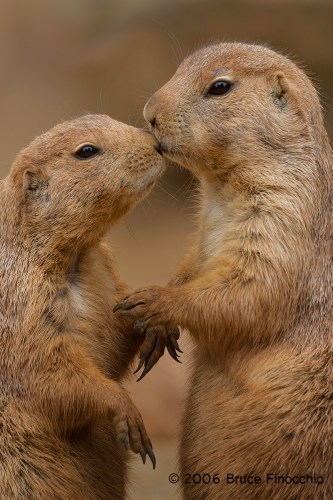
Prairie Dogs Show Affection
Now, I am not a supporter of having animals in small cages or animals treated without care, dignity, and proper respect. Wildlife Parks and zoos have become much better recently at providing good care for animals that cannot be released to the wild. In fact, I would not go to or support, any place that mistreats animals within their care. Most of us can go to local wildlife areas, preserves, shorelines, parks, preserves without the exorbitant costs of foreign travel. Here in the Bay Area, we have been blessed with a large green belt that surrounds our mostly urban areas. The San Francisco Bay itself provides great shorebird photography opportunities, being a special place on the western migration route of many birds.
Even if you are planning a trip abroad or to Africa, a trip to your local zoo, can be beneficial. By learning a new camera’s menu and controls of a recently purchased camera body, so when you get to Africa you are not fumbling with these controls and making the wrong settings decisions. Practice makes perfect or at least gets photographers a long way towards making great images. The process of photography and making images becomes second nature with practice, and allows you to be in that focused Zen-like state of total concentration.
The Face Of A Ring-tailed Lemur
For beginners especially, a local zoo can be a great place to learn, improve, and develop your technical as well as your visual skills. My favorite technique is to use a 600 mm lens to isolate subjects and remove the man-made elements that you naturally find at zoos. I have used this lens for a long time and have had much practice with it.
Male Peacock Portrait
In fact, these type of images has become a calling card—my style. One problem with long lenses is the weight, and thus I have a special cart(1) that I can wheel around with my lens, tripod, and camera, securely tied down, and ready to use at a moment’s notice. This allows me to create engaging animal portraits, without showing the hand of man.
The composition of animal portraits is very similar to that of people portraits. What to include and what to exclude decisions, posing, and the position of the animal in the frame, as well as learning how light affects your final image. Making decisions on aperture, exposure, and which shutter speed and ISO combination to use, all the while waiting for the decisive moment to occur. With the goal to capture arresting behavior and interesting facial expressions. Focusing is another element where practicing is essential. Decisive or peak moments of action and behavior are fleeting and almost split second in nature, with practice, you can capture a great percentage of these moments. Before taking that once in a lifetime trip to exotic lands like Africa, go to your local zoo or wildlife preserve and enhance your skills by practicing. I have included some of my best zoo images here for review so you can see for yourself that works of art and wonderful portraits of animals are possible.
Golden Eagle Head Shoulder Portrait
Become experience and competent with your camera, develop and improve your skills before you go to Africa, you will be rewarded that you did make this effort and happy taking the time to do so.
If you love wildlife photography like I do, then, you’ll have fun and the exciting experience watching your efforts come alive as works of art that “sings with beauty”.
She was the most beautiful and spiritual animal I saw on my September 2005 South African photography trip. I was enchanted with her; it was more than just a fancy or fanciful thought. She was everything that was wild and free about the unique animals of Africa. She embodied all that is Africa. The intense look in her eyes as she surveyed the savanna was mesmerizing. I was completely under the spell she cast with her enchanting yellow-green eyes.
Female Leopard Looking Out At Her World
Before Londolozi, my photography friends were chiding me about a leopard sighting earlier on our trip in Kruger National Park. I was driving and it was very late; I missed seeing a leopard in a tree flash lighted by a parked tour bus driver. Who at almost dark was shining light into a tree with a big flashlight alongside the road for his passengers.
We had stopped, my friend in our first vehicle was leading, and she engaged the driver and he pointed out the leopard to her. However for me, driving our second car the angle for viewing was wrong; the leopard was hidden by a big branch that hung down to the road. My companion in the back seat and I searched and searched for at least twenty minutes in vain and could see nothing, no leopard.
While my friend in the first vehicle chatted away with the tour bus driver, precious time was ticking down. We needed to get to Lower Sabie camp, a camp we had yet to visit before they closed the gate. Otherwise, we would face a large fine. Already there was hardly any light left in the sky.
Maxabene Surveying The Land
Suddenly and unexpectedly, my friend driving the first vehicle took hurriedly off as her companion in the back seat, the fourth member of our group, made her aware of the ticking time. She was leading; I was following. It was almost completely dark now and I did not want to lose her. Actually, I had no idea where we were and where was Lower Sabie Camp. I was just following.
Concentrating on my driving, I drove by the “viewing window” to see the roadside leopard. Later, my companion in the back seat when asked said, yes, he did see the “leopard but only at 30 miles hour for a few brief seconds.” I was the only one of our group that missed seeing the leopard.
Afterward, in the Lower Sabie parking lot, my friends were riding me so hard for missing this leopard sighting that I actually got angry. Something I never do. They said that I might never see another leopard and I possibly blew my one and only chance of seeing this elusive cat. “You missed your one and only chance, Bruce. You might not have another opportunity to see a wild leopard, you came all this way to South Africa and mess up your only chance.” I could not believe we were fighting over this missed sighting. In my anger, I told them to go to hell.
Maxabene Hunting In The Long Dried Grasses
I need not have worried, for our visit to Londolozi, in the nearby Sabi Sands game reserve, was just days away. Where I would have the destiny to meet this beautiful and enchanting leopard called Maxabene. It was like she was waiting for me—just for me alone. We saw other Leopards too, like the Short Tailed 5:4 Male. We had more sighting of leopards than we could have hoped and dreamed for. Not only sightings but the chance to make compelling photographs of this elusive feline species. It’s where I fell in love with the lovely and mysterious female leopard called Maxabene. Our time together was brief. However, she’ll never leave my memories of my time at the place they call Londolozi—a place that truly is a “protector of all living things”.
Plus, I have these images of Maxabene that will be with me always, as a remembrance of our brief time together.